
|
|
|
 |
|
Spain - Andalusia - Ubeda |
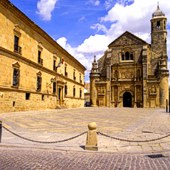
Luxury four star hotel in a sixteenth century renaissance palace This Parador was originally the palace of Dom Fernando Ortego Salido, the Dean of Malaga, who was more usually known a Dean Ortego.
The Parador is located in the aristocratic and monumental town of Ubeda. Situated in the towns' most Renaissance square and next to some of the most beautiful buildings in the area, the Parador is in a former palace built in the 16th century (altered in the 17th) which belonged to the dean of the Sacred chapel of El Salvador.
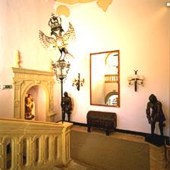
The palace was altered and renovated in the 17th century and opened as a Parador in 1930.Major restoration has been carried out by the group in 1942 and again in 1947.
The Parador is named after Ruy Lopez de Davalos, a soldier who was taken by the Moors and, after a period of captivity was allowed to return home. He was a member of the Court of Juan II who gave him the title of "Condestable" which translates as High Constable. His portrait hangs over the fireplace in the restaurant.
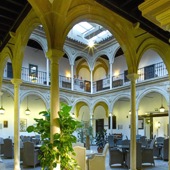
The exterior facade gives no indication of the very beautiful inner courtyard with a double gallery of which the upper part is glazed and has the guest bedrooms leading off. This area is reached by a very grand staircase from the reception floor.
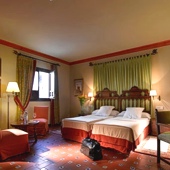
The friendly and comfortable bedrooms are large with decorated tiles on the floor and antique furniture. Six of the bedrooms and the suite look onto the Plaza de Vasquez of which the palace forms one side.
The other buildings in the square are the sixteenth century Church of El Salvador, the 17th century Church of Santa Maria, the Palacio Vazquez de Molina and the Palacio de El Marques.
The dining room is furnished in typical Andalusian style and serve both international, Spanish and regional dishes. The local dishes include:
 "Ajo blanco", a cold soup for garlic lovers;
"Pimentos rellenos de perdiz" which are peppers stuffed with partridge;
"Cabrito estofado con pinones" being a stew of kid with pine kernels;
"Morclilla en caldera" which is a local sausage;
Leading off the square is Calle Valencia which is a street where many craftsmen have their studios and where it is possible to purchase their handicrafts.Nearby is the town of Baeza which, along with Ubeda, was given the title of exemplary City during the Year of Architecture in 1975. Since this area was one of the first to be regained from the Moors by Spain, the architecture is based on the Italian renaissance period rather than Arab culture.
The main Festival in Ubeda celebrate San Miguel and is held each year from 28 September to 4 October. In late May and early June there is an International Music and Dance Festival.
While in the area, a visit to the Cazorla Natural Park is suggested for mountain scenery which is especially attractive when the leaves change colour in the autumn.
Another place to visit are the Graja Caves in the village of Jimena to look at the interesting prehistoric paintings.
This Parador has twenty two twin bedded rooms, thirteen rooms with double beds and one suite.
All the rooms have a private bathroom and telephone, satellite television, safe and a mini bar.The hotel is air conditioned and has a restaurant and bar.
Pets are not allowed.
 |
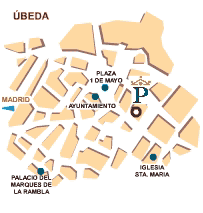 |
| The Parador is located in the Vazquez de Molina square, in the old quarter of the town, next to the sacred chapel of El Salvador, the Marques de Mancera palace and the Vazquez Molina palace, now the Town Hall. Ubeda is 39 km from Bailen along the N-322. It is 210 km from Albacete along the N-322, 57 km from Jaen on the N-321 and 330 km from Madrid, with access from the N-IV through Bailen. |