
|
|
|
 |
|
Spain - Castile - Zamora |
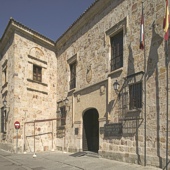
A four star luxury hotel in a fifteenth century Renaissance Palace - one of the Paradores of Spain In 1459 the Count of Alba and Aliste built his palace here on the ruins of an Arab "alcazaba" (fortress).
The building opened as a Parador in 1968 and in its conversion the cloisters and the carving on the main staircase were carefully preserved.
The cloister and the gallery above are now incorporated into the living space by the addition of large windows.The medieval atmosphere inside this Parador has been maintained with tapestries, suits of armour, noble rugs and heraldic banners.
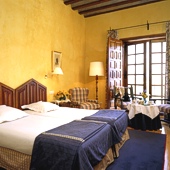
The bedrooms are large and comfortably furnished and many have four poster beds.
It is located in the historical centre of the capital of the province of Zamora and offers the traveller the opportunity to discover all the beauty of the natural, monumental and artistic surroundings of the area.
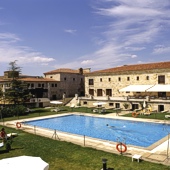
Outside, there is an attractive, well looked after garden with a swimming pool set in a large lawned area.
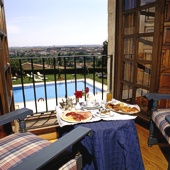
Meals may be taken in the dining room or on the terrace outside. As is usual in the Parador Group, the menu features local dishes as well as international cuisine. The regional dishes worth tasting include:
 "Bacalao a la tranca" which is a dish based on the dried salted cod that is popular though out the peninsular;With the meal, try the locally produced wine "Sangue de Toro". It comes from the local village of Toro but is usually translated as 'bull's blood'. Due to its alcohol content , moderation is advised.
"Pulpo a la sanabresa" being a dish based on octopus;
"Presas de ternera" , stuffed roast veal;
For dessert try:
"Rebojo zamorano" which is a sweet based on biscuits in a liqueur sauce, or
"Natillas almendradas" being an almond flavoured custard;Zamora is often called 'the pearl of the twelfth century' and time should be taken for a visit. The cathedral was founded in 1135. In the cathedral museum there are tapestries given in 1608 by the Count of Alba and Aliste with scenes of Hannibal's journeys and the story of Troy.
Also worth a visit is the Convent of las Duenas, and the churches of Espiritu Santo, Magdalena and San Cipriano.
Look at the statue in the main square of the famous guerilla leader, Viriatus, who won eight battles against the occupying Roman armies. The red flashes in the coat of arms of the city remember his exploits.
Toro is famous for more than its wine. A visit to the church of Santa Maria la Mayor is worthwhile. Pause to reflect on the difficulties of living in the past because you are on the site of the bloody Battle of Toro fought in 1476.
The Easter celebrations in Zamora have been declared as of "International Touristic Interest" with processions through the streets..
This Parador has forty one twin bedded rooms, five with a double bed and six suites. All the rooms have a private bathroom
The rooms have a telephone, satellite television, safe a mini bar.There is air conditioning in the hotel which has a restaurant and bar. Conference facilities are available if requested.
Animals are not allowed.
 |
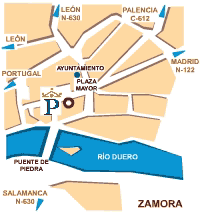 |
| Zamora is on the right bank of the Duero, at the beginning of the
western Castilian meseta. The Parador Condes de Alba de Aliste is located
in the historical centre.
To reach the Parador, turn left when you reach the 'Puente de Piedra' (Stone Bridge). If you are on the N-122 approach road to Zamora, you will come upon a park, which you should pass on the right-hand side. |